
"It really is a game changer for me. It saves time and helps me give better feedback. When you don't have to do all the sorting and organizing, you can actually get to the point of meaningful evaluation. And that's what teachers deserve."

Six to eight hours. That's how long it took Stacey Hensley to complete a single classroom observation during her first year as an assistant principal at Lubbock ISD.
The observation itself was 45 minutes. The rest was administrative work: transcribing audio recordings, manually sorting evidence into T-TESS framework categories, cutting and pasting notes across multiple documents. As a coach for 17 years, she'd focused on targeted observations. But formal evaluations required capturing evidence across all domains simultaneously. She audio recorded lessons to stay present in the classroom—then spent her evenings transcribing and organizing. By the time she finished, often late at night, she was exhausted.
This year, after three observations using her old method, Hensley tried KickUp AI Scripting. The difference was immediate.
Now Hensley types timestamped notes during observations and the AI automatically suggests which framework domains each piece of evidence belongs to. She reviews the suggestions, accepts or adjusts them, and her evidence is organized and ready to add to the evaluation form. No more evening transcription sessions. No more multi-screen cutting and pasting.
The time savings are dramatic, but something more important has changed: the quality of her evaluations.
Without administrative work draining her mental energy, Hensley now focuses on what assistant principals should spend their time doing: analyzing instruction, recognizing patterns, and developing specific, actionable feedback.
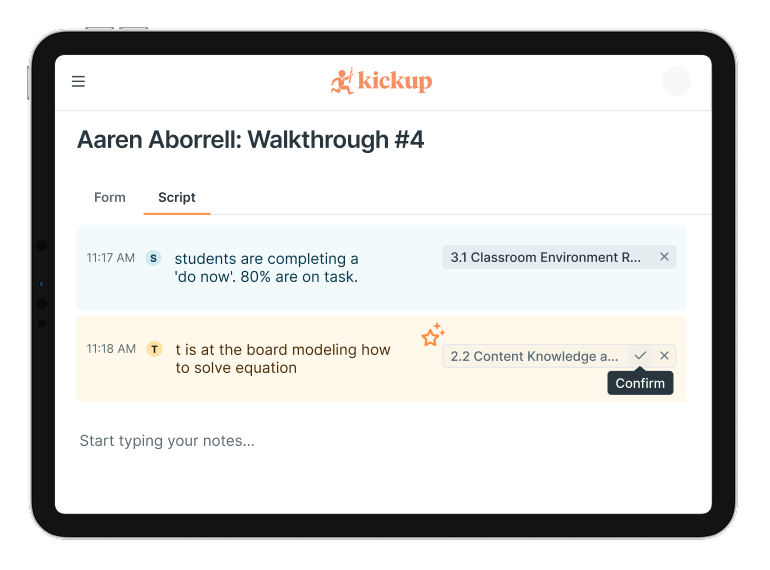
Hensley shares her scripted notes directly with teachers during feedback conversations. The timestamped evidence provides an objective record of what happened in the classroom, making evaluation decisions transparent rather than mysterious. Teachers can see exactly which moments informed her assessment and discuss any evidence they believe needs clarification.
The feedback itself has improved. Instead of generic observations based on what she could remember after hours of transcription, teachers now receive specific, evidence-grounded feedback tied directly to framework components—delivered while the lesson is still fresh and relevant.
The organized evidence also helps Hensley spot patterns she might have missed when buried in administrative work. When most of a teacher's evidence clusters around classroom culture, for example, she recognizes it as a strength area worth highlighting. The ability to see evidence organized by domain surfaces insights that scattered, unprocessed notes would have hidden.
Early in the school year, Hensley showed her staff an AI-generated watercolor of her son's wedding photo. It looked beautiful—until her son noticed his missing mustache and his wife's absent smile. She used it as a teaching moment: people who didn't know the couple couldn't see what was missing. They didn't know the nuances of the original.
The same is true in classroom observations. An algorithm can't see when a student's expression shifts from confusion to comprehension, or recognize the relationship-building embedded in a teacher's interactions. Those nuances require human judgment.
"I was the one in the room witnessing the lesson," Hensley shared. "I saw the light in a kid's eyes when they finally understood something. AI doesn't see that. You still have a responsibility to get the whole picture of what's happening in that classroom."
This is exactly the principle KickUp designed Scripting around: AI suggests, you decide. The system offers suggestions for categorizing evidence, but every decision remains in the evaluator's hands. Hensley reviews each suggestion and accepts, adjusts, or rejects it based on her professional judgment. The technology doesn't make evaluative decisions—it removes the administrative barriers that used to prevent evaluators from having the energy to make those decisions well.
Hensley also values AI's neutrality. Without personal biases or emotional context, the system provides an objective starting point for categorizing evidence—particularly helpful when navigating difficult relationships or challenging situations.
Time reclaimed: From 6-8 hours per observation to a fraction of that
Energy redirected: From administrative survival to instructional leadership
Teachers benefit: From vague feedback to specific, evidence-based coaching
The result: Better evaluations that support teacher growth
Hensley completed three observations using her traditional method before adopting KickUp’s AI-enabled scripting feature this year. She wouldn't go back.
.svg)
You can't trust everything you read on the internet.

.png)
.png)