
"We've been working on those three strategies for a long time now. The consistency is the strategy. Now with everything in one system, our principals can pull up the data and have real conversations with grade levels, content areas, or individual teachers about what's happening in classrooms."
.png)
Topeka Public Schools has three instructional priorities: teacher clarity, academic discussion, and high-level questioning. They've had those same three priorities for five years. That consistency isn't an accident — it's the foundation for everything else.
Over the 2024–2025 school year, leaders across Topeka's 30 campuses conducted more than 3,500 classroom walkthroughs and more than 1,500 district-level learning walks. The state department talks about Topeka's implementation in rooms Topeka isn't even in.
Here's what that practice looks like and how Topeka built it into something 30 campuses now own.
Topeka makes a clear distinction between two observation practices.
Learning walks are collaborative, inquiry-based classroom visits — instructional rounds for administrative teams. Every campus conducts them at least once per quarter. The full building leadership team participates: head principal, every assistant principal, the instructional coach, and the special education consulting teacher. At smaller elementary schools that might be three or four people. At the high school, it's more.
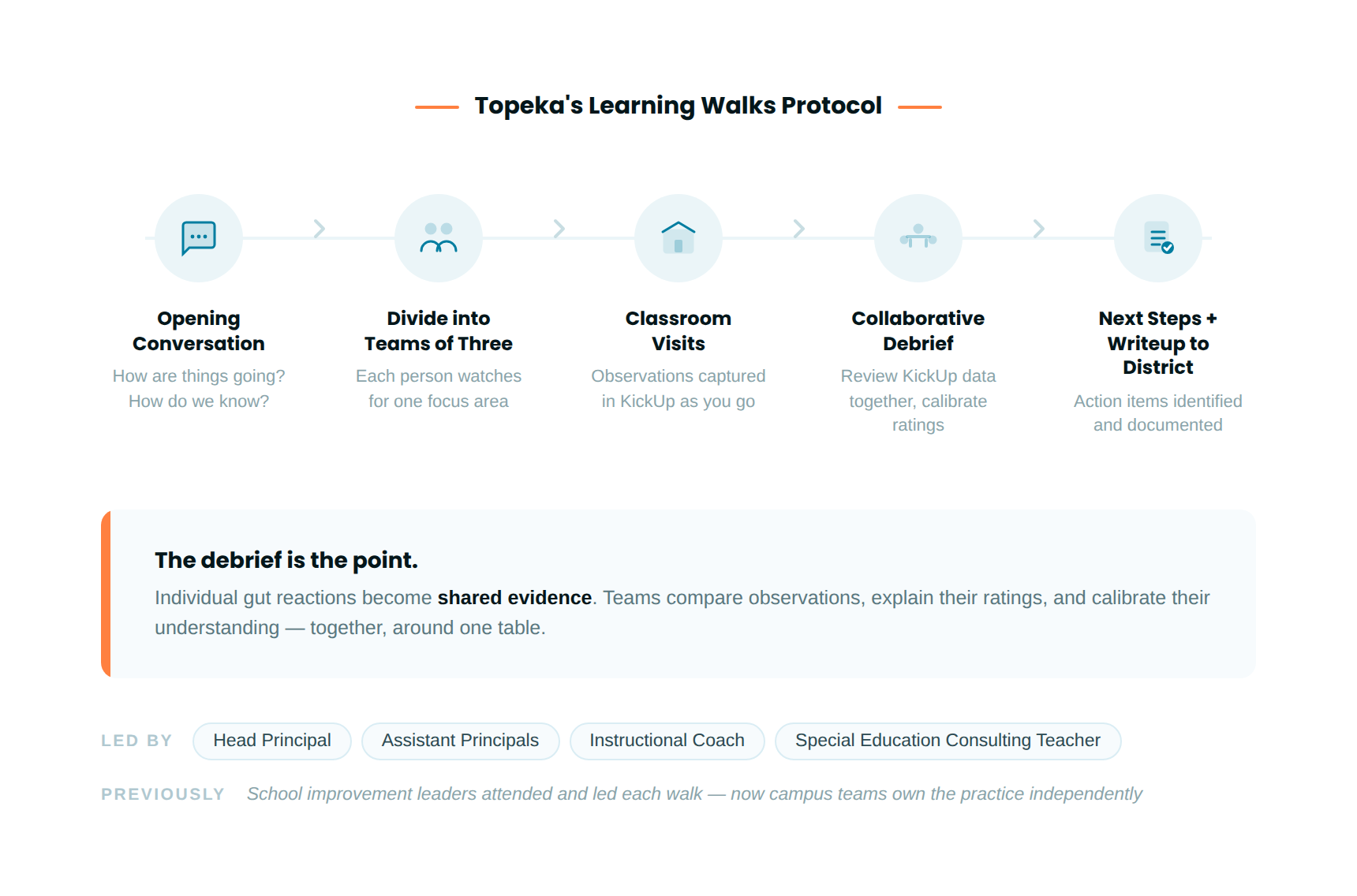
The day starts with an opening conversation. How are things going? How do you know? Before the practice was established, most answers at that point were gut feeling and impressions, not evidence. The walk is what changes that.
Teams divide into groups of three, each person watching for evidence of one focus area: teacher clarity, academic discussion, or high-level questioning. They use rubrics aligned to those three areas, drawn from the Rigor and Relevance framework and Visible Learning research. Then they get into as many classrooms as they can cover. A school with 12 classrooms might finish in two hours. A school with 120 might take a full day.
The debrief is where it comes together. Every team reconvenes around a table and walks through what they saw. That conversation where they are comparing observations, explaining ratings, calibrating understanding is the point. It's where individual gut reactions become shared evidence. Teams leave with identified next steps, and campus leaders send Angela and Dr. Macdonald a debrief writeup after every walk. The learning walk process was not new to TPS by any means. It became a more formalized and consistent experience informed by guidance and professional learning from an instructional consultant.
Regular walkthroughs happen more frequently and independently: a principal or AP dropping into classrooms throughout the week, using the same focus areas and rubrics but without the collaborative debrief.
Both practices serve a purpose. Having both visible in the same system lets district leaders understand what the numbers are actually telling them.
Topeka's three focus areas came from classroom observation data. A first year of structured learning walks across all 30 schools surfaced a clear finding: rigor was inconsistent. The Topeka team narrowed the focus, drawing on Hattie's Visible Learning research. Teacher clarity, academic discussion, high-level questioning. They've been looking for those same three things ever since. Rather than adopting predetermined priorities as if a “prescription for improvement for anyone to replicate” these specific areas of focus were identified through data analysis, observations, and reflective inquiry. Any system looking to replicate must engage in their own action research - get into classrooms, gather and analyze data, and then ask the hard questions. What does the data tell us about our needs and how might we connect the right high impact strategies to those needs? These strategies are working in TPS because the data indicated a need for increasing critical thinking skills paired with academic discussion. Other systems might determine different high impact strategies based on their data analysis.
The consistency is the strategy. Whether a principal walks into a classroom on a Tuesday morning or a full campus team conducts a quarterly learning walk, everyone is looking for the same evidence using the same language.
For years, Topeka's school improvement team organized and led every learning walk. When the district wasn't on site, the practice stalled.
Angela, her colleague Dr. Macdonald, and other district leaders made a deliberate shift last year: campuses would lead their own learning walks quarterly. They didn't want the "white badges are here" effect — the day a district visit signals to buildings that today is the day to perform. The goal was a sustainable practice that ran without them.
Angela sent reminders, collected debrief notes, and pulled up data in campus meetings to hold leaders accountable to what they'd committed to. This year, the expectation is embedded: every campus conducts learning walks at least once per quarter, completes the debrief questions, and owns the resulting data.
The district's role shifted too. Rather than leading every walk, Angela now reviews data across all 30 campuses and surfaces targeted questions in regular meetings:
"You've completed 150 walkthroughs, which shows a strong investment in the process. I noticed, though, that only 10 have occurred since January. What factors may be influencing this shift in pace? How might we help with prioritization?”"
"Let's click into Ms. Jones. She's had three consecutive walkthroughs marked 'not evident' for the same area. Have you been able to engage in a coaching conversation with her?"
The questions aren't accusations. They're starting points.
Before KickUp, Topeka ran two parallel systems. Regular walkthroughs lived in Google Forms with data flowing to a manually built dashboard. Learning walks lived in spreadsheets — spreadsheets with merged cells that prevented any computation. Angela once spent eight hours manually calculating average scores by hand for a single round of learning walks.
The two systems didn't talk to each other. Coaches carried clipboards. Changing a form question meant updating the spreadsheet architecture by hand.
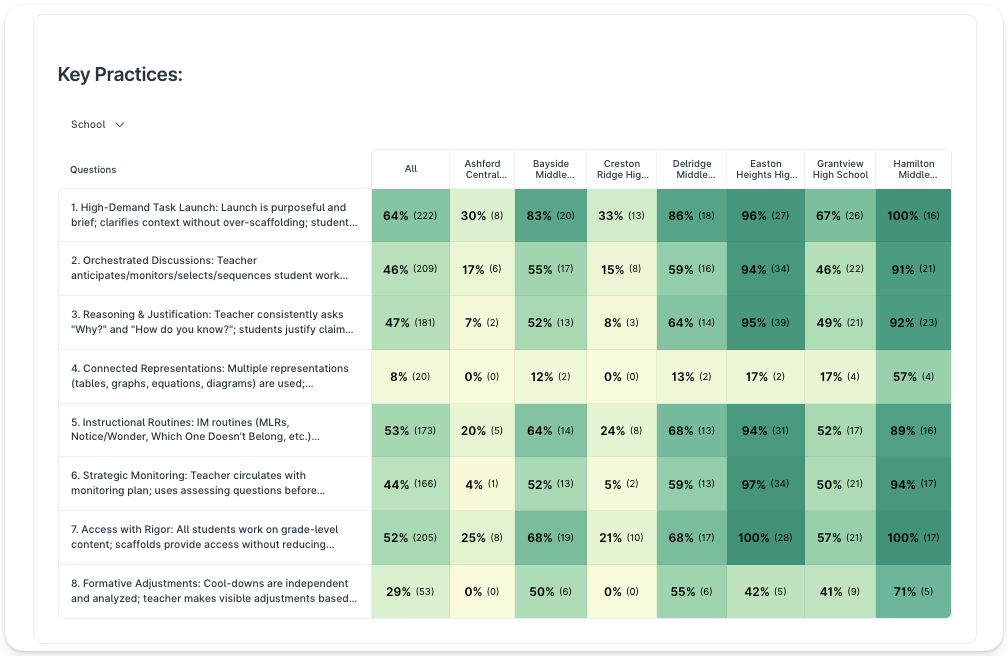
Moving to KickUp consolidated everything: walkthroughs, learning walks, and coaching logs in one system, with dashboards filtered by campus, subject, teacher, and time period. Rubrics are embedded in the form. Completion rates are visible in real time.
For coaches especially, the consolidation reduced a logistics burden that was quietly eroding compliance. When documenting your work requires navigating three platforms, it starts to feel like a second job, and it shows in the data.
Topeka's walkthrough practice has become central to the district's state accreditation process. Kansas requires districts to demonstrate not just plans, but evidence of monitoring and adjustment. The data that used to live in scattered spreadsheets now makes that evidence accessible in real time at the school level and district level simultaneously.
At a recent Building Leadership Team training, 300 educators across two evenings pulled up live KickUp dashboards alongside other district data sources. They compared their building data to district averages, examined the rubrics behind the ratings, and identified gaps before drafting their next action steps. Those teams then turned around the same process for every instructional staff member on their campus two weeks later.
That session wasn't a training event. It was a PLC for the entire district.
Other Kansas districts have reached out to learn how Topeka maintains coherence across 30 schools. The state is using Topeka's approach as an example in conversations with other systems.
One platform changes behavior, not just workflow. When walkthroughs, learning walks, and coaching logs live in the same place, leaders actually use the data.
.svg)
.png)
.png)