
"Our walkthrough data showed the vast majority of teachers were implementing strong practices. But student achievement was starkly lower. We realized we were affirming practices at a surface level without examining whether they were actually moving the needle for students. That's when we knew we had to fundamentally change how we monitored our plans."

In 2024, Temple ISD was staring down a projected D rating from the Texas Education Agency. Dr. Renota Rogers, Chief Academic Officer, remembers the disconnect: everyone was working incredibly hard, executing plans, and expecting results that reflected that effort.
But when the data came back, it told a different story. Temple wasn't struggling with buy-in or vision. They had solid plans. The problem was execution. The district wasn't truly monitoring whether those plans were being implemented with fidelity.
When Temple dug into root cause analysis, they found uncomfortable truths. Campus walkthrough data showed the vast majority of teachers implementing strong student engagement practices and using high-quality instructional materials—but student achievement remained concerningly low. Principals were marking "student engagement" as evident, but different administrators had entirely different definitions of what that meant.
The district realized they had been affirming practices at a surface level. Temple needed to work differently.
Deputy Superintendent Dr. Lisa Adams formalized the district leadership structure by establishing the DSIP (District and School Improvement Planning) Team—a core group of five leaders: herself, Chief Academic Officer Dr. Renota Rogers, Executive Directors of Elementary and Secondary Education, and the Director of Accountability and School Improvement. This team established a tightly run monthly meeting cadence with clear agendas and tracking systems. Each leader took ownership of specific campuses and reported back on progress, concerns, and follow-up actions. They started planning campus meeting agendas together and identifying next steps as a unified front.
They also created a tiered system for campus support—monthly meetings for some campuses, quarterly for others—differentiating the level of district involvement based on campus needs.
In practice, they learned something important: even high-performing campuses needed regular check-ins. Without consistent external monitoring and support, initiatives stalled.
The foundation was set. Temple had alignment at the top.
In summer 2024, the DSIP brought all campus leadership teams together for a two-day workshop anchored in the 4 Disciplines of Execution. The framework asks leaders to focus on their Wildly Important Goals, identify the lead measures that will drive those goals, keep visible scoreboards, and create regular accountability rhythms. The central question: What are the two goals that, if left unaccomplished, would mean you wouldn't hit your overall targets?
Each campus identified their two Wildly Important Goals. Not ten priorities. Two.
Rogers describes it as giving campuses permission to focus. Yes, they still needed to run their buildings and address day-to-day challenges. But these two goals would receive disproportionate attention and resources.
What Focus Looked Like in Practice
Campuses then identified lead measures—the specific, predictive actions that would move their goals forward. Some examples include:
Transparency Changed the Culture
Campuses used scoreboards to track their lead measures weekly or biweekly, pulling walkthrough data from KickUp Coaching & Walks, then shared that progress with staff every month. Teachers could see where they stood, discuss obstacles, and commit to specific improvements.
Instead of defaulting to "we need more training," conversations became more specific: What's preventing us from reaching 50% implementation? What challenges are teachers facing? What commitments can we make this month?
The work also included change management training using the book Chip and Dan Heath’s Switch. Temple anchored everything in the moral imperative of serving students and built a culture of trust where leaders felt supported in taking risks and being transparent.
Temple needed a monitoring system that could track campus improvement plans, student achievement data, and classroom walkthroughs—and more importantly, show where those three data sources aligned or diverged.
Rogers and her team built that system in KickUp. Over the 2024-2025 school year, Temple leaders conducted over 4,200 classroom walkthroughs across their 15 campuses. They also tracked professional development participation and formal evaluation data, creating a 360-degree view of teacher growth and support.
District leaders created a common walkthrough tool—their "Academic Focus Walks"—to track consistent practices across all campuses. The tool focused on what mattered most: student engagement, use of high-quality instructional materials, and alignment to state standards. District leaders conducted 447 of these walks, creating a baseline for comparison across schools.
At the same time, campuses built their own custom walkthrough look-for’s in KickUp, each aligned to their specific Wildly Important Goals. Some campuses used their forms to track aggressive monitoring techniques. Others focused on student discourse or teacher movement patterns. A few designed their walkthroughs to align directly with the state's teacher evaluation system, allowing them to avoid duplication of effort.
KickUp's dashboards allowed Rogers and her team to view all of this data—district-wide and campus-specific—in one place. They could filter by campus, by teacher, by subject, by time period. They could compare how math classrooms were performing versus social studies. They could see which teachers had been observed multiple times with the same area marked "not evident,” what professional development they'd attended, and how they were progressing on formal evaluations. This complete picture enabled leaders to ask deeper, more contextualized questions.
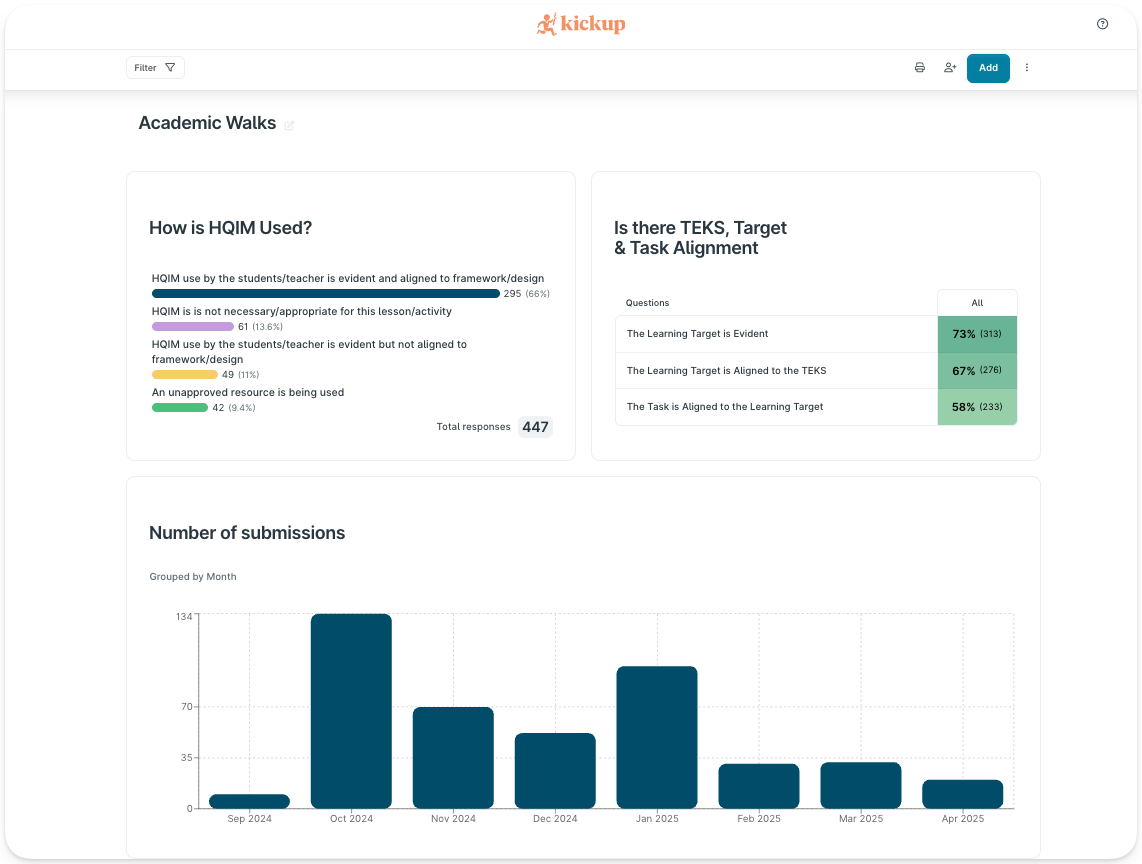
In monthly campus meetings, district leaders pulled up KickUp dashboards to look at the data together. Instead of general check-ins, conversations became concrete and focused on next steps.
"You've completed 150 walkthroughs—that's great. But it's February and you've only done 10 since January. What's happening?"
"Let's click into Ms. Jones. She's had three consecutive walkthroughs marked 'not evident' for aggressive monitoring. Have you had a coaching conversation with her? What support have you provided?"
"Your data shows math is at 35% but social studies is at 80%. Let's pull up both departments. What's happening in social studies classrooms that isn't happening in math?"
Drilling into walkthrough trends in KickUp. Data shown is illustrative, not from Temple ISD.
Some leaders also used KickUp to track coaching conversations. They could review patterns and realize when they’d spent too much time in administrative meetings with a principal and not enough time observing classrooms. That allowed them to adjust their approach in real time.
By 2025, Temple's accountability ratings told a dramatically different story:
But Rogers is most proud of the development of campus leaders into strategic, data-informed instructional leaders. Principals and assistant principals aren't just managing buildings anymore. They're using real-time data to refine their actions, asking harder questions, and building shared accountability with teachers.
Among the feedback, principals shared how:
Temple's turnaround wasn't about a single strategy or tool. It was about alignment, focus, and relentless monitoring.
At the district level, Dr. Adams, Dr. Rogers and her team formalized their collaboration, divided responsibility, and held themselves accountable for follow-through.
At the campus level, leaders identified their Wildly Important Goals, tracked lead measures, and brought teachers into the conversation with transparent data.
And across the system, leaders stopped celebrating effort without interrogating results. They used KickUp's dashboards to track walkthroughs and monitor campus improvement plans, then cross-checked that information with student achievement data—and asked the hard questions when things didn't align.
Temple had good plans before 2024. But they weren't monitoring them, questioning them, or adjusting them with the rigor needed to drive real change.
Now they are. And their campuses—and students—are winning because of it.
To learn more about how KickUp can support this work in your district, connect with us.
.svg)
.png)
.png)