
“In all my years, this was the easiest rollout I've ever done. And it's the easiest system I've worked with. You don’t get both very often.”
.png)
Kelly Schaeffer has been a school leader long enough to have lived through every iteration of teacher observation tooling, from a single sheet of paper with two questions to PDFs, district-built Google Docs, and a handful of statewide platforms in between. So when Wisconsin Rapids switched to KickUp last year and rolled out AI-powered Scripting, Kelly approached it the way veteran principals approach most new tools: with a clear head and high standards.
A year in, here’s what changed.
Wisconsin Rapids needed to move off their previous evaluation platform on a tight timeline, with 275 teachers and 16 principals to bring along. Director of Teaching and Learning Roxanne Filtz has already shared the district-leader view of that rollout: a 2-hour training, zero implementation issues, and 100% evaluator buy-in.
(Read Roxanne’s story: From Skepticism to ‘I Love This’.)
From Kelly’s seat, one of those 16 principals, the rollout held up. She didn’t need an external guide to find her way through her first observation. She didn’t need to bounce between three screens to record dates, frameworks, and notes. The form was the form, and it led her to the next step.
Kelly is a finish-before-you-leave kind of evaluator. She walks into a classroom with the observation already open, takes her notes inside the form, completes the rubric in real time as she listens in on groups, and submits before she leaves the room.
Years of practice taught her to keep up. The tool changes what she can do while keeping up, surfacing framework alignment in the moment, not after the fact, so her attention stays on the teaching.
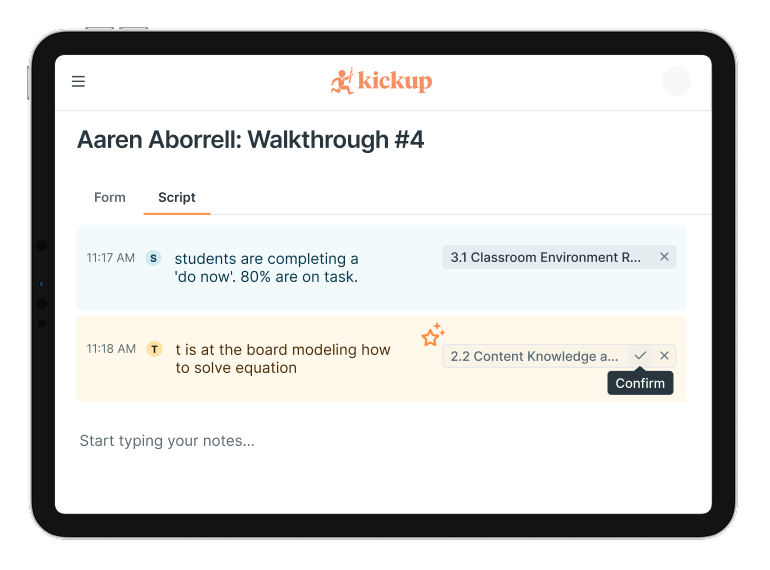
The biggest practical shift is the tagging. With paper or a Google Doc, framework alignment used to happen later — after the lesson, after the day, sometimes days later — and it relied entirely on the evaluator’s recall. Scripting suggests framework tags as notes come in, including options Kelly might not have reached for on her own.
Kelly shares her scripted notes with the teacher, tags and all. That part isn't new for her staff. What's new is how those tags shape the conversation afterward.
When framework alignment comes from the evaluator alone, feedback can feel like a judgment call. When the tool surfaces the evidence and the framework component together, the conversation shifts. It's no longer about Kelly's opinion of the lesson. It's about what was there. Teachers and principals end up looking at the same evidence.
Kelly is direct with peers who worry that an AI tool will take their judgment out of the equation: it won’t, because that’s not what it’s doing. She shares, “Think of it as an organizational tool and a facilitation tool — not a replacement for your judgment. You’re still the expert. The tool just helps you facilitate the process smoother and faster.”
Her practical suggestion: mock up an observation, practice it, delete it. The flexibility is the point. Scripting works whether you’re writing detailed running notes or completing a rubric, and it doesn’t force you into one workflow. A veteran teacher and a first-year teacher can both be observed productively through the same tool.
Kelly is moving to a new building next school year, where she'll be working with teachers she hasn't observed before. That's where she expects to lean on Scripting and the AI-powered tagging the most. Not because she needs help knowing what good instruction looks like, but because she's looking forward to having a system that helps her organize what she's seeing across a new staff.
She's also watching how the district's observation data connects to professional learning over time. Where teachers are growing, where coaching is landing, where PD should focus next.
.svg)
.png)
.png)