“Professional learning has its own KPI on our balanced scorecard, and every number in it comes from KickUp.”

When Griffin-Spalding stakeholders ask how well professional learning is landing, Dr. Tonya Steele answers from KickUp. Session feedback feeds a professional learning KPI on the district’s balanced scorecard, and the graphics and AI summary of feedback make it quick to show a stakeholder or the curriculum team how professional learning is making an impact.
KickUp was already in place when Dr. Steele joined the district four years ago, which gave her team time to settle into habits that work. Together, shared expectations and consistent routines help facilitators support staff learning, document participation, and use feedback to strengthen future opportunities. These practices also help the district communicate its professional learning progress to leadership and the stakeholders.
Like many districts, Griffin-Spalding sees a gap between the people who register for a session, the people who confirm they attended, and the people who complete feedback. That gap matters because feedback is how the district measures effectiveness.
This year, Dr. Steele made feedback required before credit appears on a transcript. She checks each facilitator’s session request in the approval workflow to confirm the required-feedback box is ticked, and she uses the optional note in the approval email to remind presenters to confirm attendance and collect feedback. She has also been visiting schools to walk coaches through the steps and plans to put the message in the weekly staff newsletter.
The numbers have moved quickly. Last year, feedback completion was under 20%. So far this fall, it’s around 70%, which puts Griffin-Spalding in the top 15% of feedback rates across the KickUp network.
Dr. Steele wanted facilitators and staff to have convenient, consistent access to professional learning resources. By organizing agendas, documents, and session materials in KickUp collections, the district gives staff a central place to find what they need, revisit their learning, and support implementation.
Now the agendas, documents, and resources for each session live in a KickUp collection, one central place for the district’s professional learning materials. Facilitators and staff can find what they need on their own, without emailing her.
Keeping everything in KickUp also helps with records. When an employee leaves and asks for a transcript, she prints it. Transcripts imported from the district’s earlier system go back to 2014. She also finds the platform easy for the people building content. New facilitators and course creators pick it up quickly, which matters when she’s training them school by school.
When Dr. Steele joined the district, the superintendent wanted professional learning to reach classified staff, such as the transportation, nutrition, and maintenance teams, and not only teachers. Tags are how the district makes that visible.
Tags are labels a district adds to each session in KickUp, like a topic or a department. Griffin-Spalding requires them on every session. They cover the professional standards a session supports, the department running it, Georgia’s teacher and leader evaluation frameworks (Teacher Keys and Leader Keys), and the evaluation standards for classified staff. Because every session carries the same labels, Dr. Steele can pull the data by any of them.
Transportation leaders, department heads, and paraprofessionals now have training in KickUp, and district leadership meetings are logged there too. Principals use the same tags to find the right session for a teacher, such as a classroom management course from student support services, and the assignment is documented in KickUp.
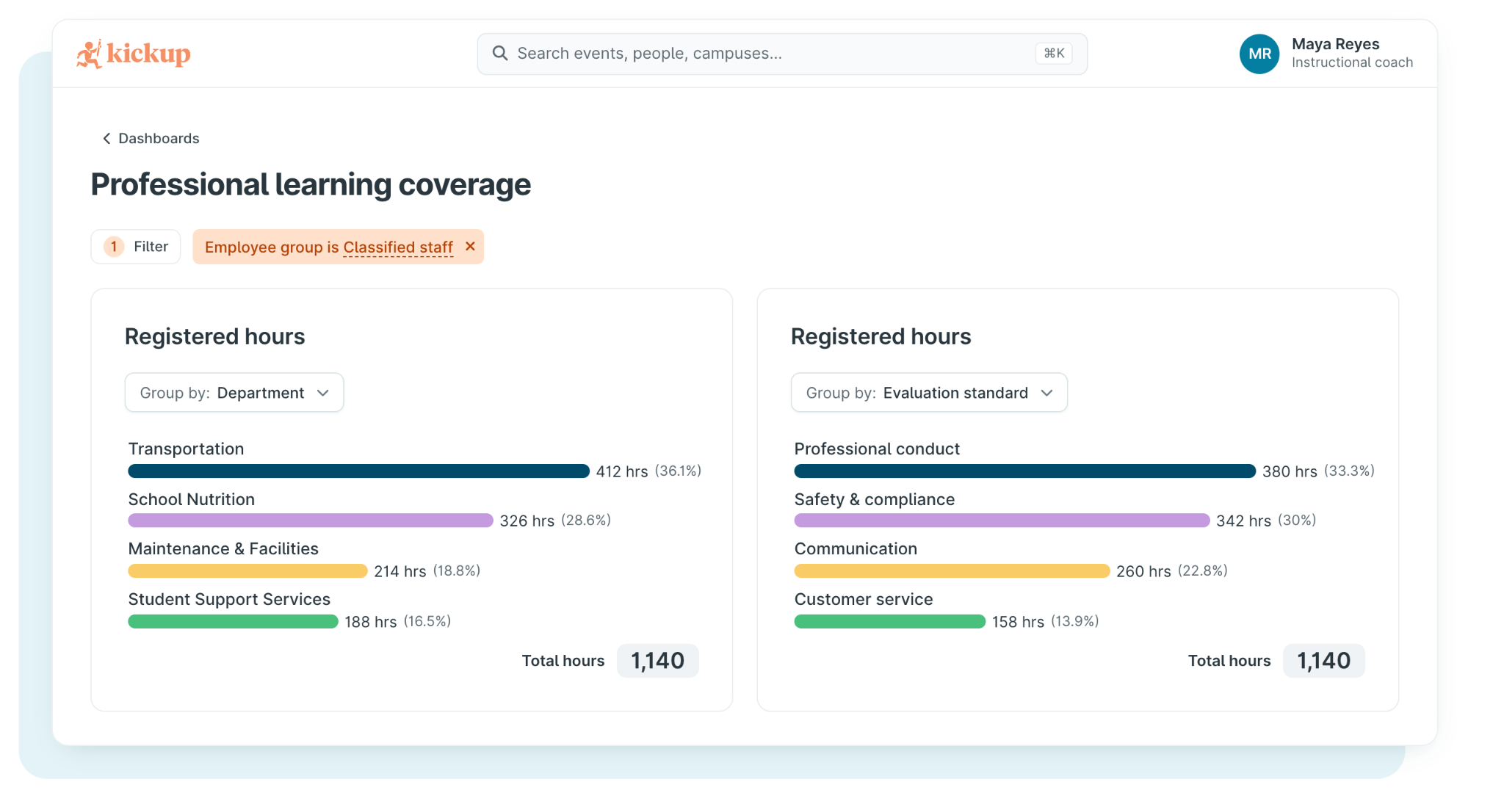
Griffin-Spalding has a three-year professional learning plan developed with an advisory committee. KickUp’s approval workflow helps Dr. Steele and session leaders connect learning opportunities to that plan, supporting a coordinated approach that reflects district priorities and staff needs.
“When I review sessions for approval and read my daily summary emails, I can see which ones line up with the goals in our plan,” she says. “That helps me make sure we’re offering opportunities that match where the district is headed.”
Mentor logs and session feedback show the district where new teachers need help, and the team acts on what they see. Classroom management concerns kept surfacing in the specific schools and entries, so this year’s sessions for new teachers are built around it, along with more chances to go into classrooms, observe, and offer extra help and resources.
That work connects to Operation Reset, a classroom management grant the district runs with Georgia State University. The sessions and resources are recorded in KickUp, so the district can show it did what it said it would do with the funding.
Tamara McCann, Teacher Recruitment and Induction Coordinator, uses KickUp to keep the new teacher mentor program on track. Mentors log their monthly meetings, observations, and hours, using Get Better Faster to guide what they focus on each month. Right now the program is focused on a small group of target schools that need extra support.
Lead mentors see their own school’s entries and no other school’s. Beyond the district team, only one or two people in the building, including the principal, can see a teacher’s entries, which keeps mentoring close to confidential. If a mentor is having trouble meeting with a teacher or finding resources, the lead mentor sees it early and can step in.
Ms. McCann reviews each school’s entries and shares updates with the lead mentors. That same data showed the district where new teachers were struggling most this year.
Districts weighing a move usually fear that years of records won’t come with them. “Our information didn’t get lost,” Dr. Steele says. “That was the biggest concern.” Griffin-Spalding smoothed the transition by pulling records going back to 2014 into KickUp from its earlier system., which built early confidence in the system. At the school level, the change came down to a round of training.
“It was an easy transition,” she says.

You can't trust everything you read on the internet.